Research steps
Elicit perceived HIV transmission risks
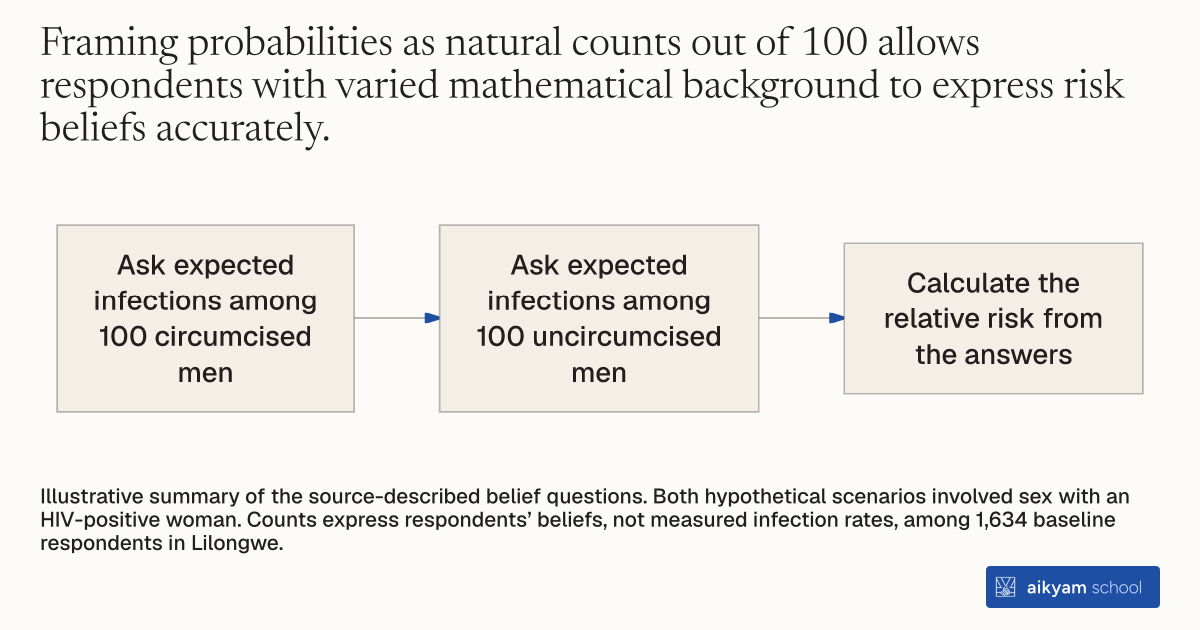
- Ask expected infections among 100 circumcised men
- Ask expected infections among 100 uncircumcised men
- Calculate the relative risk from the answers
Illustrative summary of the source-described belief questions. Both hypothetical scenarios involved sex with an HIV-positive woman. Counts express respondents’ beliefs, not measured infection rates, among 1,634 baseline respondents in Lilongwe.
See source →How
When to use
In health research, people often hold inaccurate beliefs about disease transmission risks and medical benefits. Standard binary questions fail to measure how strongly individuals hold these beliefs or how much risk they perceive. This method uses hypothetical population counts to extract precise numerical probabilities of risk from study participants.
Measure subjective transmission probabilities by asking structured questions about hypothetical groups of 100 individuals.
- Present a hypothetical scenario where 100 circumcised men each have sex with an HIV-positive woman.
- Ask the respondent to state how many of those 100 circumcised men would contract HIV.
- Present a second hypothetical scenario where 100 uncircumcised men each have sex with an HIV-positive woman.
- Ask the respondent to state how many of those 100 uncircumcised men would contract HIV.
- Calculate the relative risk ratio between the two numbers to measure individual beliefs about the protective effect of circumcision.
Why it works
Comparing responses across circumcised and uncircumcised scenarios isolates individual baseline knowledge of risk reduction.
Example
In a baseline survey in Lilongwe, Malawi, researchers asked 1,634 uncircumcised men to estimate infection counts out of 100 for circumcised and uncircumcised men. At baseline, 49 percent correctly believed circumcised men had a lower transmission risk.
About the study
Participants
1,634 uncircumcised men aged 18 to 35 residing in urban Lilongwe, Malawi.
Study Design
Baseline survey elicitation asking respondents numerical infection expectations out of 100 for circumcised versus uncircumcised men.
Results
49 percent of men held correct prior beliefs at baseline that circumcision reduces HIV transmission risk. Providing information lowered the perceived circumcised transmission rate by 8.751 per 100 and reduced relative risk by 0.094.