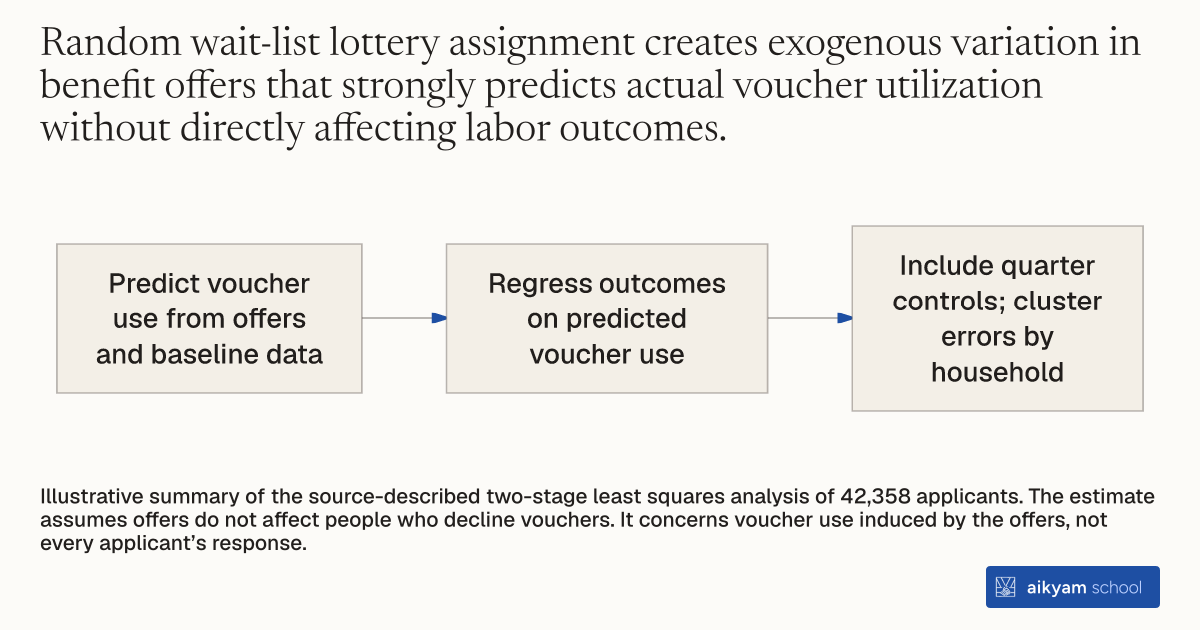
Research steps
Use random offers to estimate voucher effects
- Predict voucher use from offers and baseline data
- Regress outcomes on predicted voucher use
- Include quarter controls; cluster errors by household
Illustrative summary of the source-described two-stage least squares analysis of 42,358 applicants. The estimate assumes offers do not affect people who decline vouchers. It concerns voucher use induced by the offers, not every applicant’s response.
See source →How
When to use
In social benefit evaluations, imperfect program take-up and control group crossovers prevent direct comparisons from showing the causal impact of actually utilizing a benefit. Two-stage least squares instrumental variables estimation isolates the true causal effect on program participants using randomized offer assignment. This technique enables policy evaluators to correct for non-compliance and crossover bias.
Estimate the causal impact of program participation using randomized offer assignment as an instrumental variable in a two-stage least squares framework.
- Define a dummy variable for post-lottery voucher offers as the exogenous instrument and an indicator for active voucher lease-up as the endogenous treatment variable.
- Specify the first-stage OLS regression predicting voucher lease-up status using the post-offer indicator and baseline individual covariates.
- Compute the predicted values of voucher utilization from the first-stage regression.
- Specify the second-stage OLS regression estimating economic outcomes against predicted voucher utilization, controlling for calendar quarter fixed effects and baseline demographic covariates.
- Cluster standard errors at the household level to account for serial correlation across longitudinal observations.
Why it works
Two-stage least squares scales the intent-to-treat estimate by the difference in lease-up rates between treatment and control groups, recovering the local average treatment effect.
Example
Researchers in Chicago, Illinois, estimated a two-stage least squares model on 42,358 applicants, using wait-list offer status to instrument for voucher utilization, which showed that leasing up reduced quarterly earnings by $329.
About the study
Participants
42,358 working-age, able-bodied adults living in private housing in Chicago, Illinois (11,696 treatment group, 30,662 control group).
Study Design
Two-stage least squares instrumental variables regression of quarterly earnings, employment, and welfare receipt using randomized wait-list lottery offer status as an instrument for voucher lease-up across a 1997–2005 longitudinal panel.
Results
The first-stage regression yielded a highly significant instrument (F-statistic over 7,500 with a 40 percentage point shift in lease-up), producing IV estimates of a 3.6 percentage point reduction in quarterly employment and a $329 drop in quarterly earnings.