Try, learn and adjust
Check audit concerns lead to corrective action
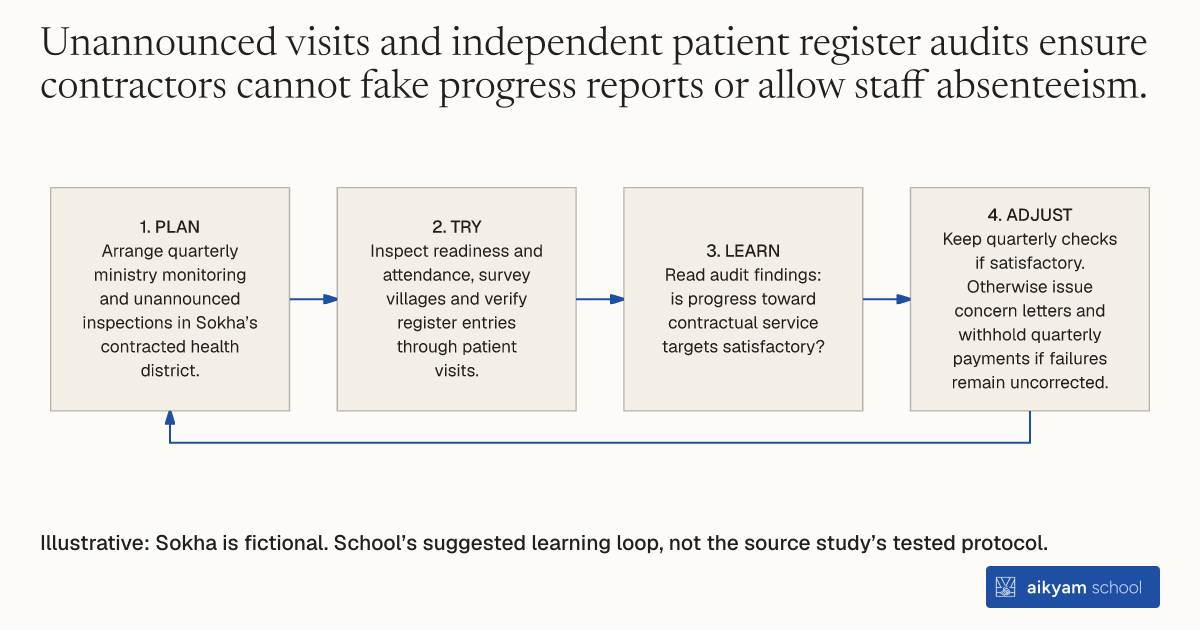
- Plan: Arrange quarterly ministry monitoring and unannounced inspections in Sokha’s contracted health district.
- Try: Inspect readiness and attendance, survey villages and verify register entries through patient visits.
- Learn: Read audit findings: is progress toward contractual service targets satisfactory?
- Adjust: Keep quarterly checks if satisfactory. Otherwise issue concern letters and withhold quarterly payments if failures remain uncorrected.
Illustrative: Sokha is fictional. School’s suggested learning loop, not the source study’s tested protocol.
See source →School’s suggested, untested loop. Observe readiness, attendance, verified treatment and corrective action. Payment withholding follows unresolved failures; it is not an automatic response to every concern.
How
When to use
Health management contracts risk poor performance or target neglect if contractor efforts are unmonitored. Standard self-reported progress data can mask operational failures or overcharge patients. Conduct unannounced supervisory visits and quarterly field audits backed by financial sanctions to enforce contractual service delivery standards.
Conduct unannounced supervisory visits and quarterly field audits backed by financial sanctions to enforce health management standards.
- Deploy independent ministry monitoring teams to conduct quarterly supervisory visits to contracted health districts.
- Perform unannounced site inspections of district hospitals and health centers to assess facility readiness and staff presence.
- Conduct random village surveys and audit patient health center registers to verify that listed treatments actually occurred.
- Issue formal concern letters to contractors when quarterly audits show unsatisfactory progress toward service delivery targets.
- Withhold quarterly contract payments if identified management or service delivery failures remain uncorrected.
- Increase regular supervisory visits by district management teams to maintain daily health center performance and supply availability.
Why it works
Financial sanctions like payment withholding provide strong financial incentives for management to fix operational problems quickly.
Example
The Cambodian Ministry of Health deployed monitoring teams to conduct quarterly audits across five contracted health districts from 1999 to 2003. When a contractor failed to make satisfactory progress toward contract goals, the ministry issued formal concern letters and sanctioned one contractor by suspending payment for one quarter until issues were resolved.
About the study
Participants
12 rural districts in Takeo, Prey Veng, and Kampong Cham provinces in Cambodia, covering 1.26 million residents across 360 sample villages with 3,700 households and 143 health centers.
Study Design
Cluster-randomized trial evaluating 12 districts randomly assigned to contracting out, contracting in, or comparison status, using initial random eligibility as an instrumental variable for actual contract rollout.
Results
Unannounced supervisory visits increased by 5.7 visits per quarter in contracting-out districts compared to a comparison mean of 2.5 visits, overall health facility management improved by up to 1.128 standard deviations, and contractual sanctions successfully enforced performance standards across five contracted health districts.