Research procedure
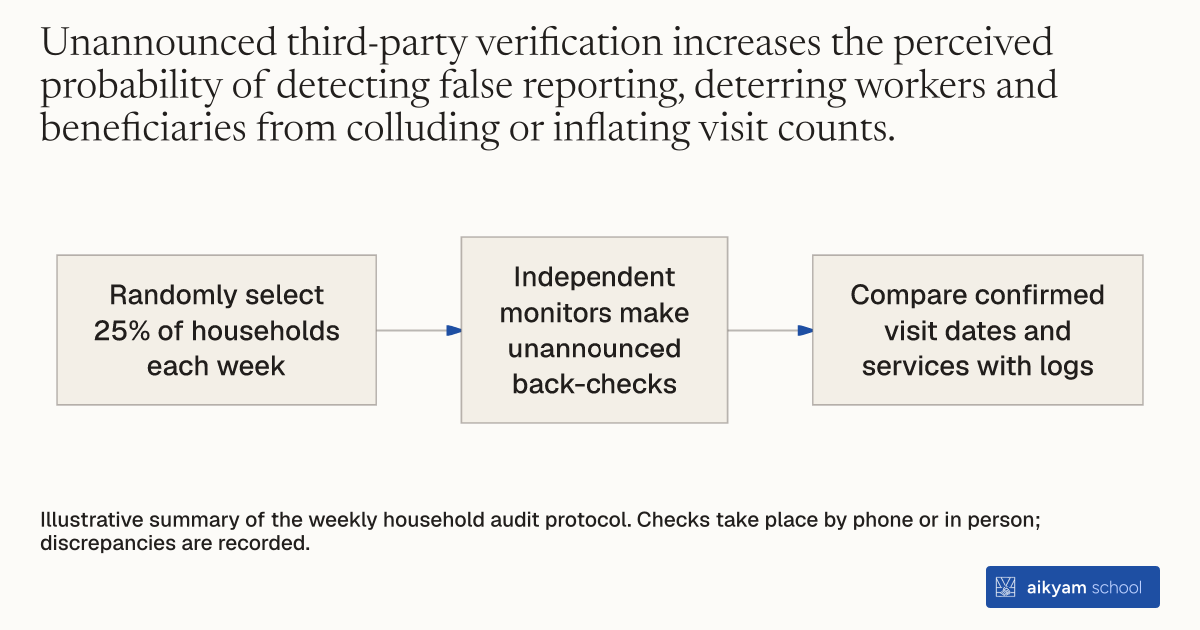
Audit reported household visits
- Randomly select 25% of households each week
- Independent monitors make unannounced back-checks
- Compare confirmed visit dates and services with logs
Illustrative summary of the weekly household audit protocol. Checks take place by phone or in person; discrepancies are recorded.
See source →How
When to use
In public service evaluation programs, self-reported performance data can suffer from reporting inflation and collusion between workers and beneficiaries. Unannounced third-party audits verify household visit occurrence and service quality. This verification mechanism deters data fabrication and ensures accurate performance tracking for program evaluation.
Audit field performance data by conducting unannounced weekly back-checks on a random sample of program beneficiaries.
- Select a random 25% sample of surveyed households each week across program evaluation sites.
- Assign an independent team of field monitors separate from local facility staff.
- Conduct unannounced household back-checks either by phone or through direct in-person visits.
- Ask household primary caregivers to confirm the exact date and service content of health worker visits.
- Cross-reference caregiver responses against health worker self-reported visit logs.
- Record audit discrepancies to detect data fabrication and prevent worker-client collusion.
Example
In Sierra Leone, independent field monitors back-checked a random 25% sample of surveyed households weekly across 372 peripheral health unit catchment areas. Monitors conducted unannounced phone or in-person visits to confirm health worker visit dates and services, finding no significant difference in reported visit rates between socially connected and non-connected households.
About the study
Participants
A random 25% weekly sample of 1,966 primary female caregivers across 372 Peripheral Health Units in Sierra Leone.
Study Design
Randomized audit protocol integrated into field evaluation, conducting weekly unannounced phone and in-person back-checks over a 10-month trial.
Results
Third-party audits verified worker visit reports without data fabrication, showing no statistically significant difference in reported visit rates between socially connected households and non-connected households (p = 0.439).