Research procedure
Observe shared-asset negotiations
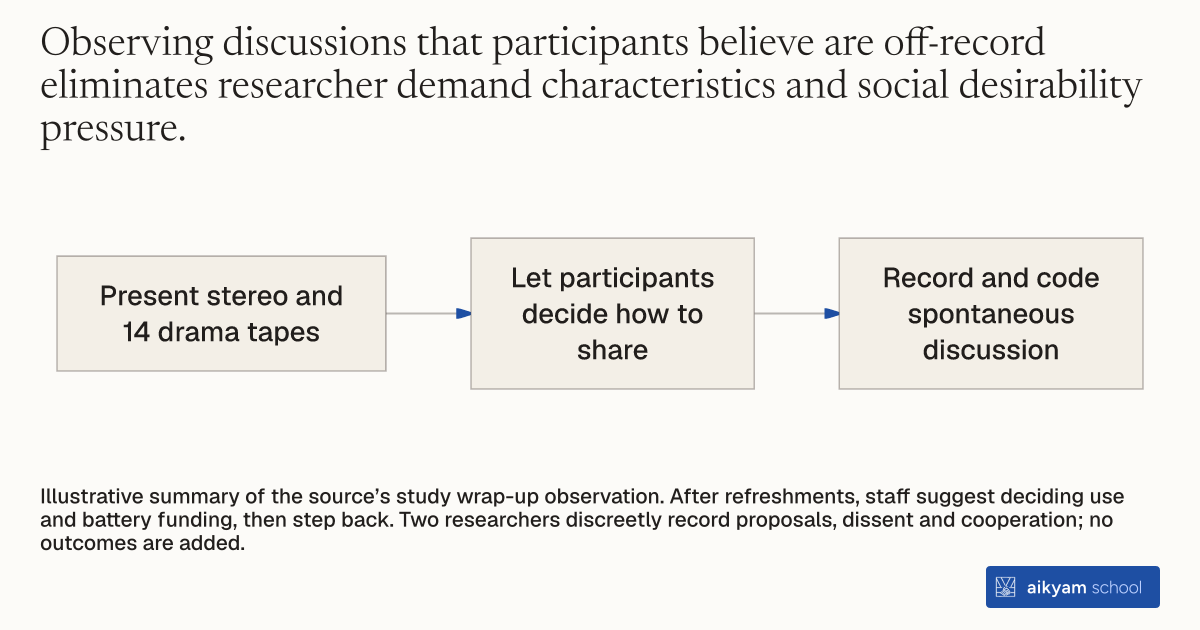
- Present stereo and 14 drama tapes
- Let participants decide how to share
- Record and code spontaneous discussion
Illustrative summary of the source’s study wrap-up observation. After refreshments, staff suggest deciding use and battery funding, then step back. Two researchers discreetly record proposals, dissent and cooperation; no outcomes are added.
See source →How
When to use
Evaluating real-world behavioral changes in post-conflict communities requires capturing unscripted group decision-making. Standard surveys and monitored exercises can trigger demand characteristics or social desirability bias, leading participants to perform expected behaviors. Unobtrusive observation of genuine asset allocation measures whether citizens express dissent and negotiate shared management off the record.
Present a valuable communal gift with unallocated management rights at a study wrap-up gathering, then observe and record spontaneous participant deliberations.
- Host a study conclusion event for participants, providing customary refreshments to mark the end of formal data collection.
- Present the community group with a valuable shared asset, such as a battery-operated portable stereo and 14 drama cassette tapes.
- Suggest casually that participants use the remaining time to decide among themselves how to share the stereo, schedule listening times, and fund batteries.
- Step back immediately to let participants deliberate spontaneously without staff moderation or direction.
- Station two researchers discreetly at the back of the group to hand-record spoken comments and proposals without drawing attention to their note-taking.
- Code transcripts for dissenting opinions following initial proposals, expressions of group cooperation, and final governance choices.
Why it works
Presenting a tangible asset forces participants to engage in actual collective governance and dispute resolution.
Example
At the conclusion of a one-year radio study across 14 sites in Rwanda, researchers presented each group with a portable stereo and cassette tapes, observing significant differences in how reconciliation and health drama groups negotiated ownership and usage.
About the study
Participants
556 participants across 14 community clusters in Rwanda (50% male, average age 38.9 years), including general population villages, prisons, genocide survivors, and Twa minorities.
Study Design
Unobtrusive behavioral evaluation following a year-long group-randomized trial, where researchers presented a communal stereo at a goodbye party, discreetly hand-recorded unprompted deliberations, and analyzed transcripts using Mann-Whitney U and Wilcoxon signed-rank tests.
Results
Reconciliation drama groups expressed significantly more dissenting opinions regarding asset management than control health groups (Mann-Whitney z = 2.64, p < 0.01; Wilcoxon z = 2.17, p < 0.03) and voiced more positive comments about group cooperation (z = 2.59, p < 0.01), whereas control health groups routinely defaulted to surrendering the stereo to local authorities without debate.