Research steps
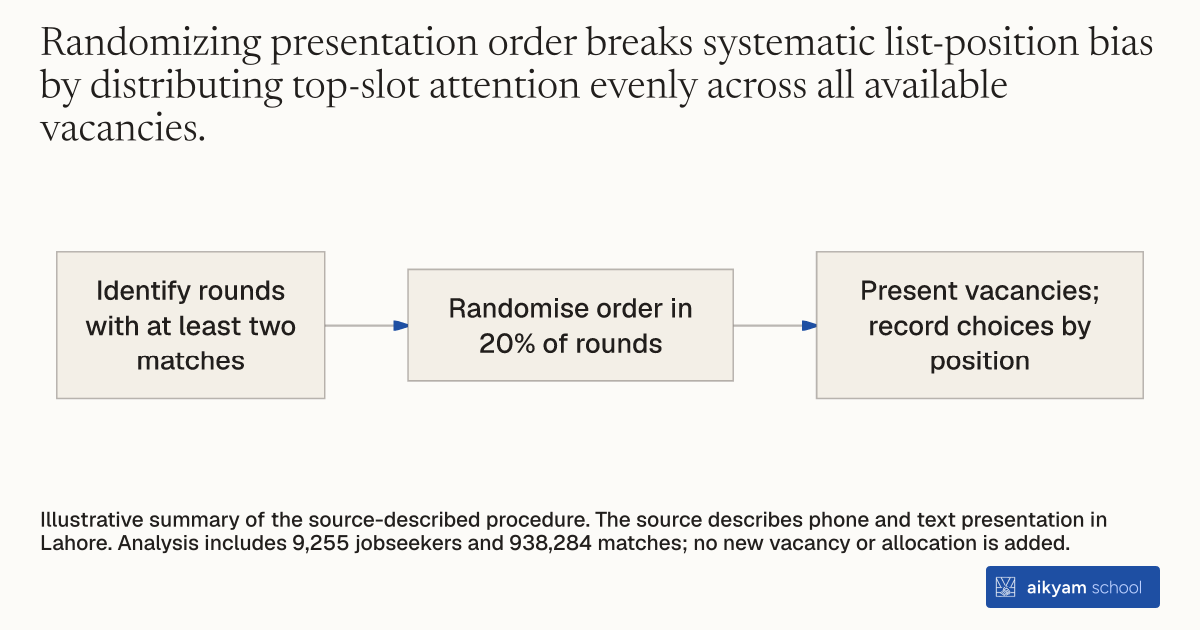
Randomise vacancy presentation order
- Identify rounds with at least two matches
- Randomise order in 20% of rounds
- Present vacancies; record choices by position
Illustrative summary of the source-described procedure. The source describes phone and text presentation in Lahore. Analysis includes 9,255 jobseekers and 938,284 matches; no new vacancy or allocation is added.
See source →How
When to use
Job search platforms presenting multiple vacancies sequentially often induce positional bias toward top-listed items. Randomizing the presentation sequence of vacancies across candidates balances search attention across positions. It is intended for employment platforms evaluating whether top-slot placement alters applicant selection or application yield.
Randomize the order in which matched job vacancies are presented to candidates in platform communications.
- Identify all matched vacancies generated for a candidate during an active matching round.
- Select a subset of candidate matching rounds to receive randomized vacancy presentation orders.
- Program the platform server to randomly scramble the listing order of matched vacancies for each candidate.
- Read or list the matched vacancies in the newly assigned randomized sequence during phone calls or text notifications.
- Record candidate application choices for each vacancy position to measure positional order effects.
Why it works
This allows platforms to distinguish whether candidates apply to jobs based on true match preferences or simple top-of-list salience.
Example
On the Job Talash platform in Lahore, Pakistan, researchers randomized the presentation order of matched vacancies across 938,284 jobseeker-vacancy matches in 20% of matching rounds. Listing a vacancy first increased application probability by 0.44 percentage points, but yielded a lower interview probability of 2.44% compared to 6.29% for standard choices.
About the study
Participants
N = 9,255 jobseekers across 938,284 jobseeker-vacancy matches in Lahore, Pakistan; restricting to matching rounds with two or more matches.
Study Design
Randomized Controlled Trial embedded in matching rounds (20% of rounds) randomizing the presentation order of vacancies on phone calls and text messages.
Results
Listing a vacancy first increased application probability by 0.440 percentage points (p < 0.001), but marginal applications induced by top-slot placement yielded an interview rate of 2.44% (p = 0.077 relative to 6.29% control rate), demonstrating decreasing returns to forced top-slot exposure.