Research comparison
Compare randomly assigned applicants
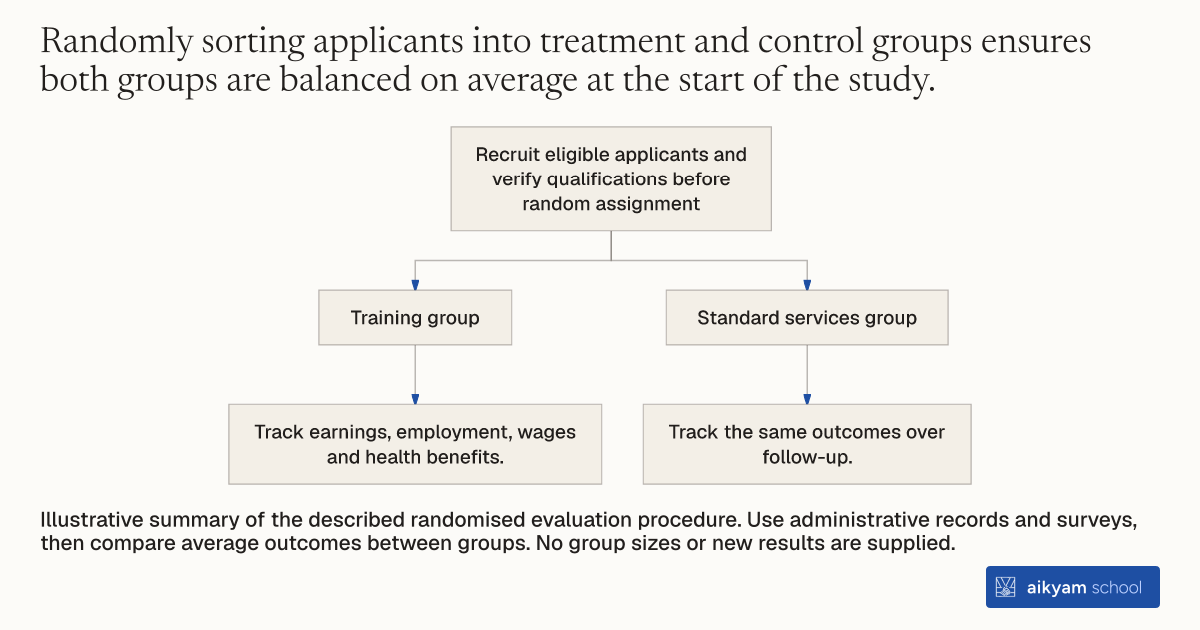
Recruit eligible applicants and verify qualifications before random assignment
- Training group
- Track earnings, employment, wages and health benefits.
- Standard services group
- Track the same outcomes over follow-up.
Illustrative summary of the described randomised evaluation procedure. Use administrative records and surveys, then compare average outcomes between groups. No group sizes or new results are supplied.
See source →How
When to use
Workforce programs often struggle to prove whether participant earnings gains result from training quality or unobserved candidate motivation. Non-experimental evaluations create selection bias because highly motivated applicants self-select into training programs. Program evaluators solve this problem for policymakers by using randomized controlled trials to measure causal program impacts.
Evaluate workforce program impacts using randomized controlled trial methodology with treatment and control groups.
- Recruit eligible applicants and verify basic program eligibility criteria prior to random assignment.
- Randomly assign qualified candidates into either a treatment group receiving training or a control group receiving standard services.
- Track labor market outcomes across treatment and control groups using administrative earnings records and longitudinal surveys.
- Measure earnings, employment rates, hourly wages, and health benefit access at regular post-enrollment intervals.
- Estimate causal program impacts by calculating statistical differences in average outcomes between treatment and control groups.
Why it works
This balance allows evaluators to isolate the causal impact of the workforce intervention from unobserved participant characteristics.
Example
Evaluators used a randomized controlled trial to measure the impacts of the Sectoral Employment Impact Study across Per Scholas, JVS Boston, and WRTP.
About the study
Participants
Human low-income adult and youth job seekers across nine sectoral programs in the United States.
Study Design
Randomized controlled trial methodology comparing treatment and control group outcomes across two to eleven years post-enrollment.
Results
Randomized evaluations proved sectoral programs causally increased two-year participant earnings by $4,500 (an 18 percent increase, p < 0.01) in the Sectoral Employment Impact Study and eleven-year earnings by $4,616 (a 15 percent increase, p < 0.01) in Project QUEST.